Love Sleep Embroidery Design
First Impression: Soft, Timeless, and Instantly Recognizable
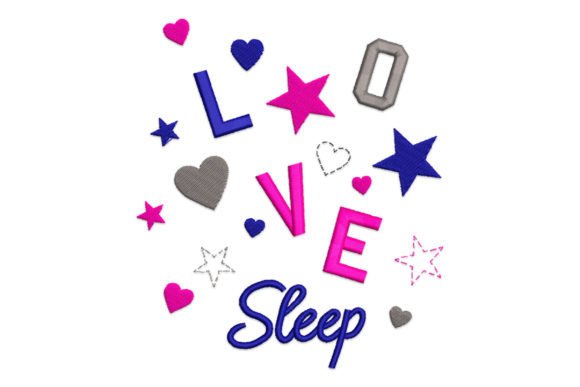
As an embroidery designer who’s prepped over 200 craft fair booths—and watched thousands of shoppers pause at a single stitch—I’ll say it plainly: Love Sleep lands with quiet confidence. It’s not loud or trendy; it’s soft, intentional, and emotionally resonant. The pairing of stars and hearts suggests gentle wonder—not baby cliché, but universal calm. It reads as modern nursery, yes—but also fits seamlessly on a minimalist tea towel for a boutique café or a linen pouch sold alongside slow-living journals. No forced whimsy. No gendered overload. Just warmth, rhythm, and balance. That’s rare. And that’s why it sells.
Where Love Sleep Shines in Real Craft Fair Displays
In my booth setup—tote bags stacked at eye level, aprons draped over a ladder shelf, pillow covers propped against a reclaimed wood frame—Love Sleep stands out most when scaled intentionally:
- Tote bags: Centered on natural canvas or oat-colored linen, it reads clearly from 6 feet away. Not too dense, not too sparse—ideal for a quick visual hook.
- Pillow covers: Especially 16”–20” square covers in linen-cotton blends. The stars and hearts nestle beautifully into corners or float mid-panel, adding handmade charm without overwhelming the fabric texture.
- Embroidered patches: This is where Love Sleep becomes a quiet bestseller. Small (3”–4”), cleanly finished, and easy to iron-on or hand-stitch to denim jackets, backpacks, or baby blankets. Customers love taking home *one* meaningful motif—not a full scene.
- Tea towel embroidery: Works brilliantly on medium-weight cotton towels—especially when placed just below the hanging loop. The design’s open spacing avoids muddying the weave, and the hearts retain shape even after repeated washing.
- Small pouches & market bags: On curved seams or tapered sides, Love Sleep holds its integrity better than script-heavy or tightly packed designs. Its symmetry and clean outlines translate well across irregular surfaces.
What Holds It Back—And How to Work Around It
Let’s be practical: Love Sleep isn’t bulletproof on every surface. As a machine embroidery design, it demands thoughtful execution—not because it’s flawed, but because subtlety requires precision.
On caps, avoid placing it across the front curve unless you’ve tested hoop clearance and stabilizer hold. Stars with fine points can distort; hearts with tight inner curves may pucker if stitch density isn’t balanced. Likewise, on textured towels (like waffle-weave or heavy terry), use cutaway + tear-away combo stabilizer—don’t rely on lightweight fusible alone.
For dark fabric, test thread contrast rigorously. Pale blush or silver metallic thread may vanish on charcoal linen. Stick with high-contrast options: navy on cream, deep rose on oat, or charcoal on ivory. And never skip a real mockup—printable mockups lie. A photo of Love Sleep on your actual tote bag fabric tells you more than ten digital previews.
Selling Smarter: Online, In-Person, and at Scale
Etsy sellers and small shop owners will appreciate how Love Sleep photographs. Its balanced composition means fewer cropping headaches, less post-editing, and stronger thumbnail recognition. Paired with warm natural lighting and a neutral background, it conveys handmade quality—not “crafty,” but considered.
For batch production? Yes—it’s repeatable. The design avoids micro-details (no eyelashes on stars, no serifed lettering), so stitch consistency stays high across 50+ pillow covers or 100+ patches. But always check your embroidery file’s hoop size requirement and stitch density. If the file packs stars and hearts too tightly into a 4x4 hoop, you’ll see thread buildup and fabric distortion—especially on lightweight cotton.
And here’s what I tell every creative entrepreneur before they list Love Sleep as a commercial embroidery product: verify licensing. If you’re selling finished goods (not the digital file), confirm the design allows commercial use. If reselling the embroidery file itself, ensure redistribution rights are granted. Don’t assume.
Design Notes You Can’t Skip Before Stitching
This isn’t theory—I’ve learned these the hard way:
- Test Love Sleep on scrap fabric *in your exact production setup*: same thread, same stabilizer, same machine tension.
- Check spacing between stars and hearts—crowding kills breathability. If elements touch or overlap, adjust digitizing or choose a slightly larger scale.
- Confirm hoop size compatibility with your most-used items (e.g., 5x7 hoops for pillow covers, 4x4 for patches).
- Inspect stitch density visually—not just in software. Dense fills on small stars may sink into plush fabrics; outline-heavy versions pop better on textured surfaces.
- Use appropriate stabilizer: cutaway for knits and stretchy fabrics, tear-away for stable wovens, and ultra-lightweight for sheer linens.
- Create at least one physical mockup before ordering bulk fabric—lighting, drape, and stitching all change perception.
- Compare thread colors across fabric swatches. A “soft peach” thread may read pink on ivory but beige on oat.
Why Love Sleep Belongs in Your Next Booth Rotation
Love Sleep strengthens your booth story—not as filler, but as emotional punctuation. It signals care, calm, and craftsmanship. It doesn’t shout “baby!”—it whispers “belonging.” That makes it versatile across categories: Bed, yes—but also Home, Gift, and Lifestyle. It elevates a simple tote bag into a keepsake. It turns a tea towel into a conversation starter. It gives your Etsy listing a cohesive, ownable voice amid algorithm noise.
For handmade product makers, this isn’t just another embroidery file. It’s a design asset with staying power—gentle enough for nurseries, grounded enough for adult spaces, and clear enough to scale across products without losing meaning. In a weekend craft fair, where attention spans are short and tactile impressions are everything, Love Sleep earns trust before a single word is spoken.