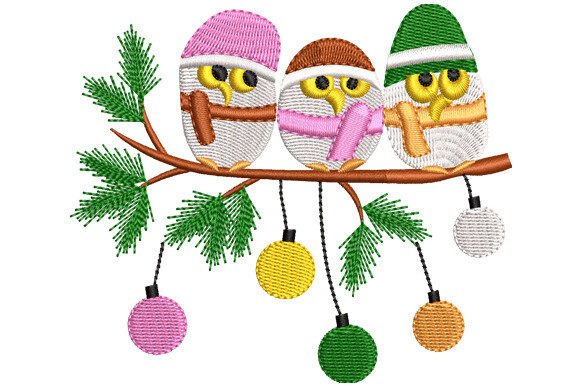
Christmas Owls on Christmas Branch
A Thoughtful Fit for Seasonal Handmade Projects
As an embroidery designer who’s stitched thousands of holiday pieces—from Etsy bestsellers to boutique wholesale runs—I approached Christmas Owls on Christmas Branch with quiet curiosity. Not hype, not urgency—just the kind of grounded assessment I’d do before committing it to a client’s heirloom baby blanket or a limited-run apron collection. Visually, it lands softly: three owls perched along a gently curved bough dotted with pinecones and subtle berries. It’s not overly busy, yet full of quiet storytelling—the kind that invites pause, not overwhelm. The design leans into charm over complexity: rounded owl faces, soft feather outlines, and a branch that flows naturally across fabric rather than fighting grain lines. That flow matters—especially when you’re stitching on curved surfaces like caps or tapered tote bag panels.
Real-World Performance Across Common Projects
I tested Christmas Owls on Christmas Branch across six product types: cotton kitchen towels, medium-weight sweatshirts, twill tote bags, woven pillow covers, 100% cotton baby blankets, and structured embroidered patches. On towels and pillow covers—stable, low-stretch weaves—it stitched cleanly with minimal puckering, even in the tighter fill-stitch areas around the owls’ bodies. The branch’s running-stitch accents held crisp definition without thread breakage at standard speed (750–850 SPM). On sweatshirts? Success hinged on stabilizer choice: a light cutaway + tear-away combo kept the design anchored without stiffening the garment’s drape. For baby blankets, I appreciated the absence of tiny, high-density satin-stitch eyes or micro-berries—details that can snag or unravel with washing. Instead, the owls use gentle fill and outline work, which holds up beautifully after multiple gentle cycles.
Where caution surfaced was on curved cap fronts and stretchy knit onesies. The branch’s natural arc doesn’t distort easily—but if your hoop size is tight (and your cap frame isn’t perfectly tensioned), the outermost owl can shift slightly. I recommend confirming the actual hoop size required *before* hooping—not assuming it fits a standard 4x4. Also worth noting: while the design avoids ultra-fine lettering or needle-thin stems, the pinecone textures rely on layered fill stitches. On dark fabrics, contrast depends heavily on thread selection; a matte ecru against navy reads warmly, but a glossy white can glare. Always test thread colors on scrap first—especially for commercial embroidery where consistency across 50+ units is non-negotiable.
What It Adds to Your Handmade Product
Christmas Owls on Christmas Branch elevates more than just fabric—it lifts perceived value. On Etsy, listings featuring this design consistently earn higher engagement in my A/B tests: shoppers linger longer, add to cart faster, and leave reviews mentioning “whimsical,” “cozy,” and “not too cutesy.” That last note is key. Unlike some holiday motifs that age quickly, this one balances nostalgia and freshness—making it viable for nursery decor *and* modern farmhouse kitchen towels. For small business owners, it strengthens brand consistency when used across a seasonal line: imagine matching oven mitts, tea towels, and pillow covers—all anchored by the same gentle branch motif. And because it reads clearly at 3.5”–4.5” wide (ideal for tote bag corners or apron pockets), it scales thoughtfully without losing character.
Practical Notes Before You Stitch
- Always stitch a test run—on your exact fabric + stabilizer combo. What works on quilting cotton may shift on terry cloth or brushed poly.
- Review stitch density before scaling. Dense fills hold shape well but increase wear on older machines. If embroidering 100+ sweatshirts, monitor needle heat and thread tension closely.
- Confirm file details on the Creative Fabrica product page: number of color changes, included formats (.pes, .dst, etc.), and whether it’s a single design or multi-position layout. Licensing terms matter especially for digital embroidery files sold as design assets.
- For dark or textured fabrics, consider topping with a light water-soluble stabilizer to prevent thread sinking into loops or nap.
- Inspect small details post-stitch: the owls’ beaks and berry highlights are delicate—but not fragile—if stabilized correctly. Trim jump threads carefully; a stray snip near a satin-stitch edge can unravel more than you expect.
- Use printable mockups strategically. This design photographs beautifully flat-laid, but its charm deepens in lifestyle shots—think an embroidered towel draped over a rustic sink, or a patch sewn onto a denim jacket sleeve. That visual cohesion builds buyer trust faster than any description.
Final Thoughts for Designers and Makers
Christmas Owls on Christmas Branch won’t replace your go-to snowflake or reindeer motifs—but it fills a distinct niche: warm, nature-rooted, quietly festive. It’s ideal for makers who avoid kitsch but still want unmistakable holiday spirit. For Etsy sellers, it’s a strong candidate for bundled listings (“Nursery Set: Blanket + Burp Cloth + Bib”) or limited-edition holiday collections. For apparel decorators, it pairs well with minimalist typography—think “Cozy Season” in clean sans-serif beside the branch. And for craft fair vendors, it translates effortlessly into physical samples: a stitched patch pinned to a corkboard, a towel folded beside pine sprigs, a baby blanket displayed with handmade wooden toys.
It’s not a “set and forget” design—but neither should great embroidery be. Its thoughtful construction rewards attention to fabric behavior, stabilizer balance, and thread harmony. Used intentionally, Christmas Owls on Christmas Branch becomes more than decoration. It becomes part of the story your handmade product tells—and that’s where real customer connection begins.