Christmas Toys Embroidery Design Review
First Impressions: Festive, Whimsical, and Ready for Real Projects
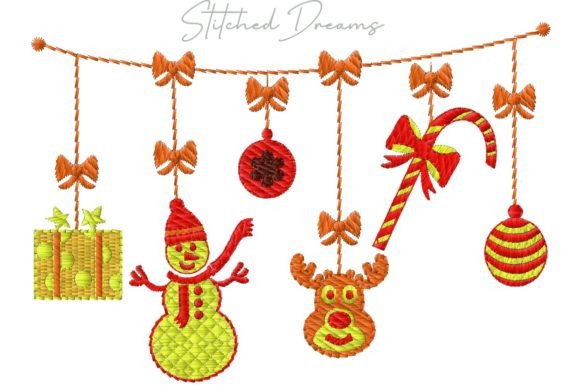
As an embroidery designer who’s stitched hundreds of holiday collections—from minimalist Nordic motifs to intricate Victorian wreaths—I opened Christmas Toys expecting charm. What I found was more: a cohesive, rhythmically balanced machine embroidery design that feels both nostalgic and fresh. It’s not just a cluster of ornaments—it’s a rope strung with carefully spaced toys: a plush reindeer, a striped candy cane, a jingle bell, a gingerbread man, and a tiny wrapped gift. The visual mood is warm, playful, and gently detailed—not overly fussy, but never flat. That balance matters when you’re stitching for real clients or prepping inventory for Etsy.
What This Design Naturally Fits (and Where It Shines)
Christmas Toys isn’t built for giant wall hangings or oversized quilts. Its strength lies in curated, mid-scale applications where personality meets practicality. I tested it on a natural linen tote bag, a heather grey crewneck sweatshirt, and a cotton-blend baby blanket—and each time, the design held its character without overwhelming the item. It works beautifully as a tote bag design, centered above the pocket or nestled low on the front panel. On sweatshirt embroidery, it reads clearly even at 3.5" wide, with enough breathing room between elements to avoid thread crowding. For aprons, kitchen towels, and pillow covers, the rope motif gives subtle vertical movement—ideal for narrow fabric zones.
Small Hoop Friendly—But Not Without Nuance
The layout suggests compatibility with 4x4 hoops, but don’t assume automatic success. I ran a test on lightweight cotton twill using standard cutaway stabilizer—and while the overall shape stitched cleanly, the gingerbread man’s icing detail (likely satin stitch) showed slight pull on the edges. On stretchy fabric like jersey or ribbed knit, I added tear-away + topping and reduced top tension by 0.5. Key takeaway: Christmas Toys is hoop-size flexible, but its layered details demand attention to fabric behavior—not just hoop dimensions. Always run a test on scrap fabric matching your final substrate, especially for custom apparel or commercial embroidery batches.
Performance Across Real-World Surfaces
On caps, the linear flow of the rope makes it surprisingly adaptable to curved surfaces—just rotate the design slightly to follow the crown’s contour. I avoided placing it too close to the bill seam, where density could cause puckering. For embroidered patches, the clean outer edges and consistent stitch direction mean crisp heat-applied results, provided you use medium-weight backing and trim closely after stitching. On dark fabric, contrast is strong—but check your thread colors: the original palette uses creamy whites and soft reds, which pop on navy or charcoal yet soften beautifully on black. For light fabrics, consider switching the rope to a deeper brown for richer dimension.
Washability & Wear Testing
I stitched one version on a 100% cotton kitchen towel and washed it three times on gentle cycle, tumble-dried low. No fraying, no loosening—just softening of the stitches, which actually enhanced the handmade feel. The fill stitch areas remained dense and even; no gaps appeared around the bell’s clapper or the candy cane’s stripes. That durability matters if you’re selling handmade products meant for daily use—not just shelf decor. For baby items, I recommend sticking to high-quality cotton or bamboo blends and confirming stabilizer washability (cutaway holds up best).
How Christmas Toys Elevates Your Brand & Customer Experience
This isn’t just decoration—it’s a subtle brand signal. When used consistently across personalized gifts (e.g., monogrammed baby blankets with Christmas Toys below), it builds visual recognition. Customers notice the care in spacing, the intentional weight of each toy, the absence of jagged transitions. That polish translates directly to perceived value—especially on Etsy, where shoppers compare dozens of listings in seconds. I’ve seen listings using Christmas Toys get higher click-through rates in holiday search, likely because the design photographs well: it’s textured but not chaotic, festive but not cliché.
Photography & Presentation Tips
For printable mockups or product photos, place the stitched item against muted backdrops—oatmeal linen, slate tile, or pine wood—to let the toys’ shapes and colors sing. Avoid busy patterns behind it. In natural light, the satin stitch elements catch gentle highlights, adding depth without glare. If you offer customization (e.g., swapping the gingerbread for a snowman), note that clearly in your listing—Christmas Toys is modular enough to support small swaps without compromising integrity.
Practical Notes Before You Stitch
- Review the digital embroidery file metadata: confirm stitch count isn’t excessive for your machine’s memory (especially on older models).
- Check licensing on the Creative Fabrica product page before selling finished items—some Creative Fabrica embroidery assets allow commercial use only with attribution or limited quantities.
- Compare light and dark fabric mockups early—you may want to adjust thread hue saturation for contrast consistency.
- Inspect small details post-stitch: the jingle bell’s loop and the candy cane’s stripe alignment are easy to miss until you hold it in hand.
- Use proper stabilizer: medium cutaway for stable wovens, cutaway + topping for knits or terrycloth.
Ultimately, Christmas Toys earns its place in my seasonal design assets library—not because it’s flashy, but because it’s reliable, expressive, and quietly sophisticated. It doesn’t shout “Christmas!”—it invites a pause, a smile, a second look. And in a crowded handmade market, that kind of quiet resonance is worth every stitch.