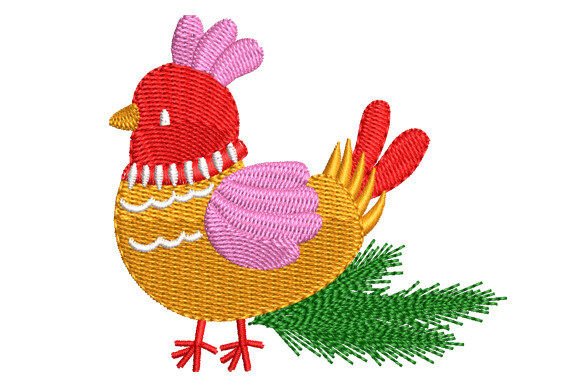
Christmas Chicken Embroidery Design
A Practical Review for Small Business Merchandise & Branded Patches
As an embroidery designer who’s developed and tested hundreds of machine embroidery designs for small business clients—from cozy cafés and indie florists to handmade pet brands and seasonal boutiques—I approached Christmas Chicken with a very specific question: Does this design translate into real-world brand assets—not just holiday charm? The answer matters most when you’re ordering 50 embroidered patches for staff aprons, stitching 200 tote bags for a holiday pop-up, or adding a chest logo to custom apparel for your Etsy shop.
First Impression: Playful, Personable, and Professionally Approachable
The name Christmas Chicken immediately signals warmth, wit, and seasonal cheer—without leaning into cliché or overused motifs. Based on the description—“a delightful Christmas Chicken embroidery design… the perfect way to infuse personality into your clothing”—this isn’t a stiff, formal emblem. It reads as friendly, handmade, and intentionally lighthearted, making it ideal for businesses that want to stand out through authenticity rather than polish alone. Think: a local bakery wrapping gingerbread cookies in burlap sacks, a craft studio selling ceramic mugs with hand-lettered tags, or a pet boutique offering festive bandanas. That tone supports brand identity without undermining professionalism—it’s joyful, not juvenile.
Real-World Performance Across Business Applications
Christmas Chicken shines where personality meets practicality. As an embroidered patch, it holds visual weight at 2.5"–3.5" without losing legibility—ideal for attaching to denim aprons, canvas tote bags, or flannel work shirts. On caps, it works best on structured front panels (not curved low-profiles) where its shape and character remain intact. For café staff uniforms, it adds memorable flair to left-chest placement—small enough to avoid overwhelming, bold enough to spark conversation.
On tote bag design, Christmas Chicken functions beautifully as a centered focal point or subtle corner accent—especially when paired with minimal text like “Est. 2018” or a shop monogram. As a sleeve detail on crewneck sweatshirts or a pocket motif on linen aprons, it reinforces handmade product storytelling. And for event merch or customer gifts—think holiday market bundles or loyalty program perks—it delivers instant recognition and shareable charm.
Where to Use Christmas Chicken With Intention
This design isn’t built for every surface. Exercise caution with:
- Cap fronts under 2"—fine details (like beak texture or feather definition) may blur at tiny scale;
- Highly textured fabric (e.g., heavy bouclé, thick terry cloth)—stitch density could lift or distort without proper stabilizer;
- Dark uniforms without high-contrast thread colors—test white, gold, or cream thread against navy or charcoal for visibility;
- Items requiring frequent washing (e.g., kitchen aprons, reusable produce bags)—confirm stitch density allows flexibility and durability;
- Curved or uneven surfaces (like rounded ceramic mugs with fabric sleeves or contoured backpacks)—always test hoop placement and fabric tension first.
How Christmas Chicken Strengthens Brand Identity
For small businesses, consistency isn’t about uniformity—it’s about resonance. Christmas Chicken strengthens brand identity by offering a recognizable, repeatable visual cue that customers associate with warmth, craftsmanship, and seasonal sincerity. When used across apron embroidery, cap embroidery, and tote bag design, it creates visual continuity that builds trust—especially for handmade product lines where buyers value story and soul over sterile perfection.
It also lifts perceived product value: a simple cotton tote becomes a collectible; a plain staff shirt becomes part of a cohesive, thoughtfully branded experience. That engagement translates directly to buyer retention—customers remember how your brand made them feel during the holidays, not just what they bought.
Essential Embroidery Designer Notes Before Production
Before digitizing or stitching Christmas Chicken for commercial embroidery, run these checks:
- Test in black and white first—does the silhouette hold up without color cues? This reveals clarity issues early;
- Verify performance at your target patch size—especially if using 1.75"–2" for cap fronts or sleeve accents;
- Review thread color contrast on your actual fabric swatch—not just on screen;
- Inspect spacing between elements—tight loops or overlapping shapes may cause nesting or skipped stitches;
- Confirm hoop size compatibility with your embroidery machine and intended garment placement;
- Test on real fabric with correct stabilizer—cutaway for knits, tear-away for stable wovens, fusible for lightweight linens;
- Create a printable mockup for client approval before bulk production—this avoids costly rework;
- Compare alongside existing design assets—does Christmas Chicken complement your logo, typography, and other holiday motifs?
- Confirm commercial licensing before using on merchandise for resale—verify usage rights for small business merch, custom apparel, and digital embroidery file distribution.
Remember: a great embroidery file is only as strong as its execution. Christmas Chicken gives you expressive potential—but smart testing, intentional placement, and thoughtful thread selection turn that potential into polished, professional finished product.
Final Thought: Personality With Purpose
In a crowded marketplace, small businesses win with distinction—not decoration. Christmas Chicken succeeds because it balances festive spirit with functional versatility. It doesn’t shout. It smiles, winks, and invites connection—while still holding its own as a durable, scalable, commercially viable embroidery asset. Whether stitched on a barista’s apron or embroidered onto a limited-run tote for your Etsy shop, it reminds customers that behind every product is a person, a story, and a little holiday heart.