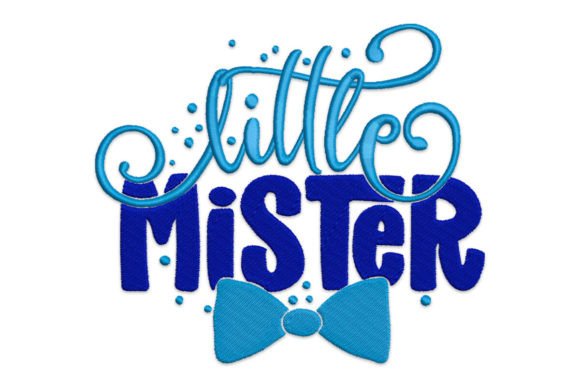
Little Mister Embroidery Design
A Whimsical Yet Professional Asset for Small Business Branding
As an embroidery designer who’s developed and tested hundreds of machine embroidery designs for small business merch, I approached Little Mister with both creative curiosity and commercial rigor. The title alone—Little Mister—immediately signals approachability, warmth, and a gentle, human-centered charm. Combined with the description—“a charming and whimsical representation of a young boy, who exudes playfulness and innocence”—this isn’t just decorative embroidery; it’s a ready-made brand voice. It reads as handmade, friendly, and intentionally nostalgic—not cartoonish or overly stylized. That balance makes Little Mister uniquely suited for businesses that want to project sincerity, care, and quiet confidence: think neighborhood bakeries, indie florists, children’s boutiques, pet-friendly cafes, or artisanal craft studios.
Where Little Mister Shines in Real Business Applications
In my studio, I test every design across six high-impact small business use cases—and Little Mister delivers consistently across most:
- Embroidered patches: Its clean silhouette and expressive but uncluttered shape hold up beautifully at 2.5”–3.5” sizes. Ideal for sew-on or iron-on application on tote bags, denim jackets, or staff aprons.
- Apron embroidery: Positioned on the chest or pocket, Little Mister adds personality without overwhelming utility—it feels intentional, not promotional.
- Cap embroidery: Works best on structured front panels (not curved bill edges) where its upright posture reads clearly. Avoid low-profile caps unless scaled carefully.
- Tote bag design: Scales well to 4”–5” when centered on canvas or cotton duck—its whimsy softens the utilitarian feel of the bag while reinforcing brand warmth.
- Staff uniforms & work shirts: As a subtle left-chest accent, it communicates culture—not corporate rigidity. Perfect for teams that value authenticity over formality.
- Product packaging accents: When stitched onto fabric tags, linen pouches, or gift wrap bands, Little Mister elevates handmade product perception and supports premium pricing.
Strategic Placement: Where to Use Little Mister Thoughtfully
Even strong designs have limits—and recognizing them is what separates professional embroidery execution from amateur trial-and-error. With Little Mister, exercise caution in these scenarios:
- Small patch sizes under 2”: Fine facial details and delicate limbs may blur or disappear. Always run a test stitch at target size before bulk production.
- Curved surfaces like cap bills or knit beanie fronts: The upright, grounded stance of Little Mister can distort visually if stretched across tight curves—stick to flat or gently rounded areas.
- Dark or heavily textured fabrics: Heavy tweed, corduroy, or deep navy twill can mute subtle thread transitions. Boost contrast with brighter thread colors (e.g., buttercream, sky blue, or warm charcoal) and confirm stabilizer choice matches fabric weight.
- High-frequency wash items: While the design itself isn’t inherently fragile, dense stitching in small areas (like hands or hat brims) benefits from tear-away + cutaway stabilizer layering—especially for café aprons or daycare staff wear.
How Little Mister Strengthens Brand Identity and Customer Trust
For small businesses competing on connection—not scale—Little Mister functions as more than decoration. It’s a visual shorthand for values: kindness, attention to detail, and joyful intentionality. Unlike generic script logos or stock icons, this machine embroidery design carries emotional resonance. Customers subconsciously associate it with care—whether stitched on a bakery’s flour-dusted apron or a florist’s reusable tote. That builds trust faster than a slogan ever could. It also supports visual consistency across touchpoints: the same embroidered patch appears on staff uniforms, customer gifts, and event merch—creating cohesion without repetition fatigue. And because it leans into “whimsical” rather than “cute,” it avoids infantilizing your brand—even if you serve adults. Think of it as the embroidered equivalent of a warm, steady smile: professional, memorable, and quietly confident.
Practical Designer Notes Before You Stitch
Before integrating Little Mister into your next commercial embroidery project, run these essential checks:
- Test the digital embroidery file in black and white first—to assess clarity, spacing, and legibility without color distraction.
- Verify how it renders at your smallest intended hoop size and patch dimension—don’t assume auto-scaling preserves integrity.
- Review thread colors against your base fabric. A pale yellow Little Mister on ivory linen reads softly elegant; the same on charcoal felt needs higher contrast (e.g., oatmeal + slate gray).
- Inspect stitch density—especially around facial features and clothing folds. Overly dense areas risk puckering on lightweight cottons or knits.
- Always test on your actual fabric with your chosen stabilizer. Linen behaves differently than poly-cotton blends; denim demands heavier backing.
- Create a printable mockup for client approval—show Little Mister on aprons, caps, and totes so stakeholders visualize real-world impact.
- Compare Little Mister beside your other design assets (logos, fonts, patterns). Does it harmonize—or clash—in tone, weight, and proportion?
- Confirm commercial licensing applies to your use case. Since Little Mister is positioned for small business merch, double-check terms for resale, staff wear, and digital distribution.
Final Thought: More Than a Boy—A Brand Signature
Little Mister isn’t just another boys category embroidery file. It’s a versatile, emotionally intelligent tool for small businesses building identity through tactile, human-made detail. Whether you’re an Etsy seller launching your first line of handmade aprons, a local studio embroidering staff caps for a new coffee roastery, or a craft brand adding charm to organic cotton totes—Little Mister brings cohesion, character, and quiet professionalism to every finished product. Used thoughtfully, it doesn’t just decorate merchandise—it deepens relationships.